Skip to content
Alloy Theory
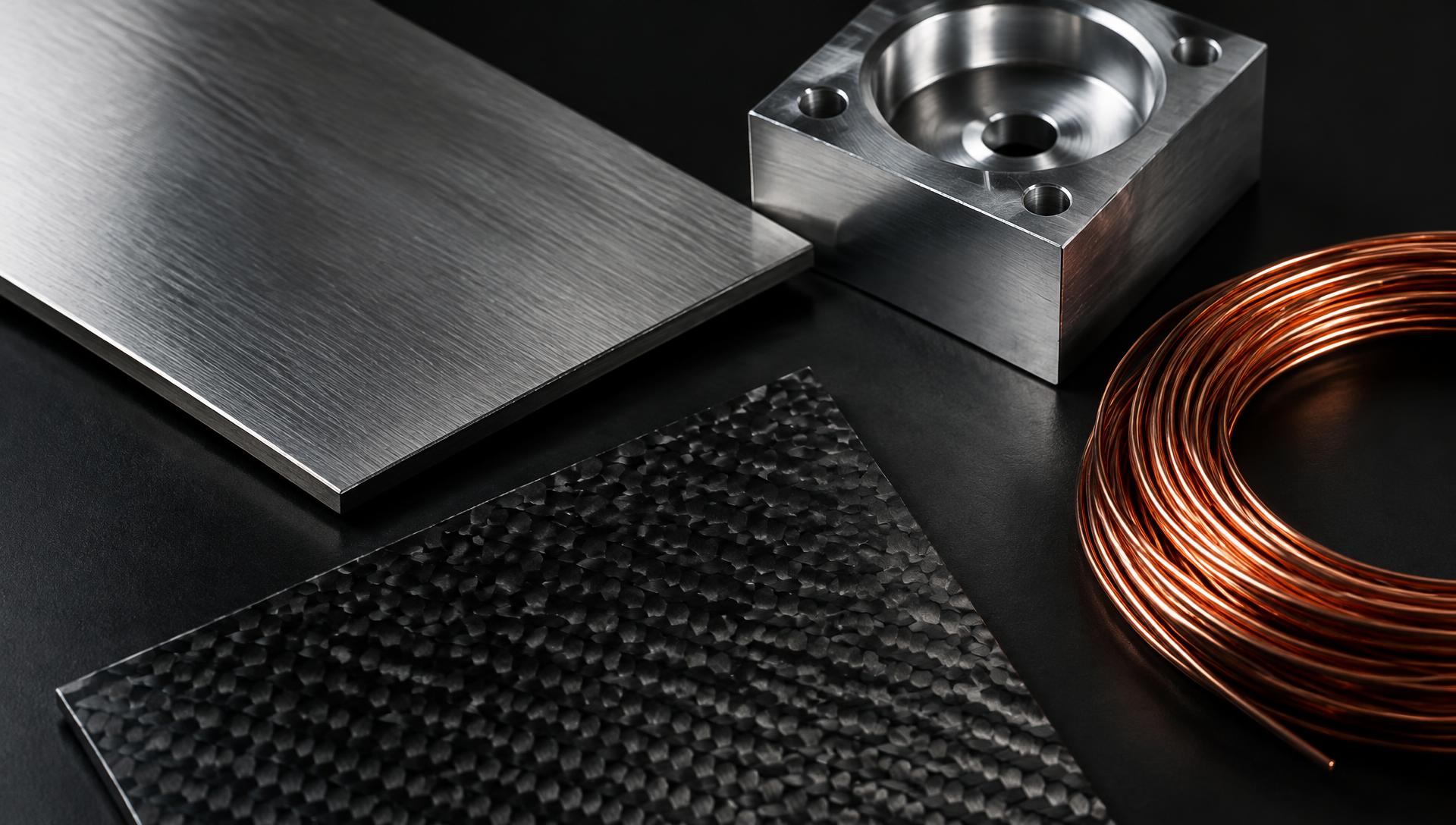
Brushed steel plate, machined aluminum block, carbon fiber panel, and copper wire on a black surface

Automotive Materials and Vehicle Manufacturing

The Science Behind Every Vehicle

Explore the materials, engineering principles, and manufacturing processes that shape modern vehicles. Discover what automotive components are made of, why different materials are selected, and how they are transformed into finished parts.

01 / Materials Library

Automotive Materials Library

Every vehicle is a carefully balanced mix of materials. Open any entry to learn what it is, how it behaves, and where it is used.

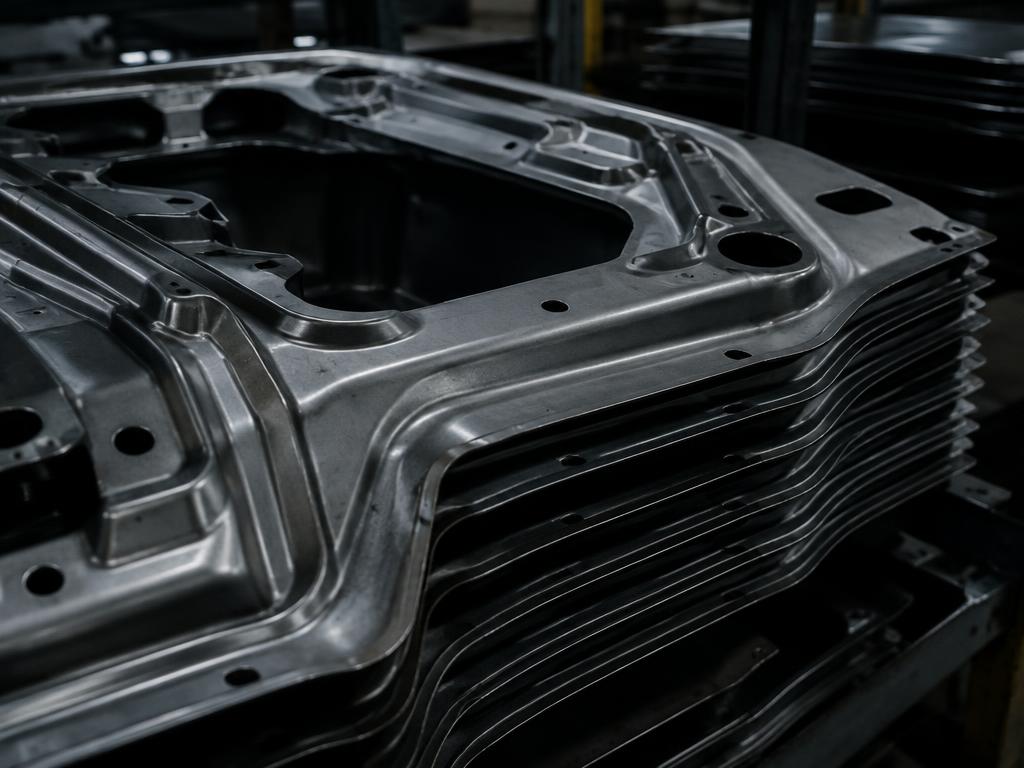
Stack of stamped steel automotive body panels

Fe-01

Automotive Steel

The backbone of most vehicle bodies, valued for its strength, formability, and ease of welding.

Learn more about automotive steel
What it is
Steel is an alloy of iron and carbon, often with small additions of manganese, silicon, or other elements. Mild and conventional steels are rolled into thin sheets that can be pressed into body panels and structural parts.
General properties
High density, good tensile strength, excellent formability, and predictable behavior under load. It is easy to weld, repair, and recycle.
Advantages
  • Low material cost
  • Mature, well understood manufacturing
  • Highly recyclable
  • Easy to join by spot welding
Limitations
  • Heavier than aluminum or composites
  • Prone to corrosion without coatings
  • Lower strength grades need thicker sections
Common vehicle uses
Floor pans, outer body panels, doors, hoods, brackets, exhaust components, and many chassis parts.
Why manufacturers choose it
Manufacturers often choose steel when cost, high-volume production, and repairability matter more than saving every kilogram.
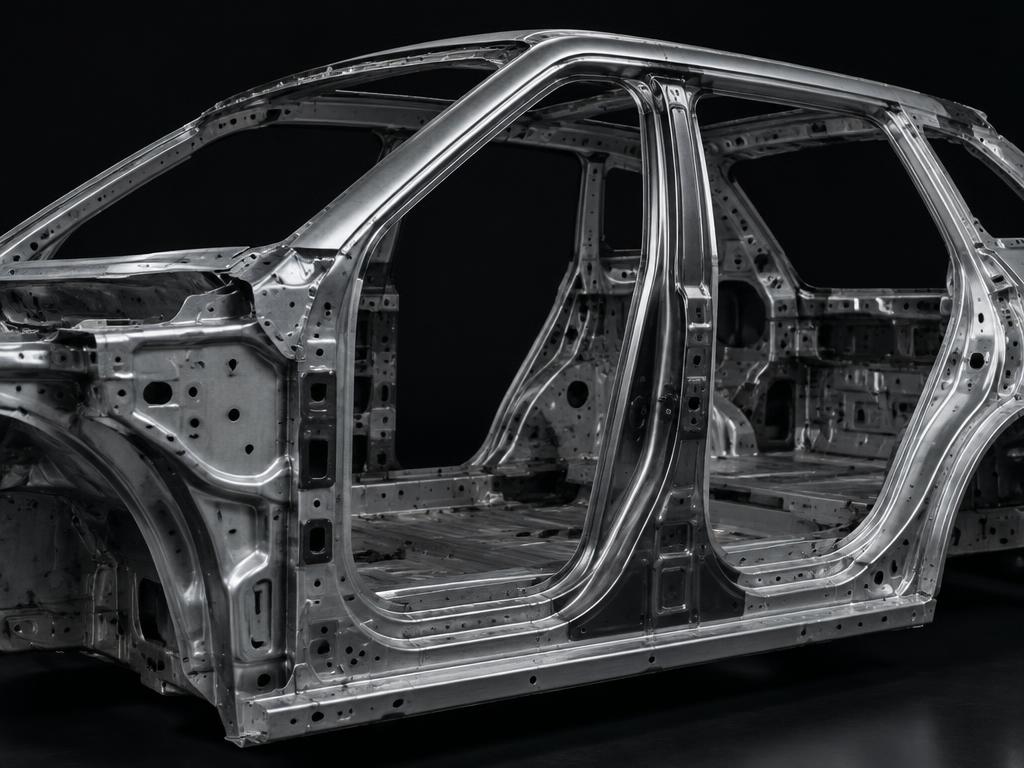
Bare vehicle body structure showing high-strength steel pillars and rails

Fe-02

High-Strength and Advanced High-Strength Steel

Engineered steels that deliver more strength per millimeter, allowing thinner and lighter safety structures.

Learn more about high-strength and advanced high-strength steel
What it is
High-strength steels (HSS) and advanced high-strength steels (AHSS) use controlled chemistry and heat treatment to create microstructures such as dual-phase, martensitic, and press-hardened grades.
General properties
Very high tensile and yield strength, good energy absorption, and reduced formability compared with mild steel. Press-hardened grades are formed hot and quenched in the die.
Advantages
  • Enables thinner, lighter parts
  • Strong crash energy management
  • Works with existing steel infrastructure
Limitations
  • Harder to form and trim
  • Greater springback during stamping
  • Some grades are difficult to repair after damage
Common vehicle uses
A and B pillars, roof rails, rocker panels, door intrusion beams, bumper reinforcements, and crash structures.
Why manufacturers choose it
AHSS lets engineers reduce mass in the safety cage while keeping the cost advantages of steel.
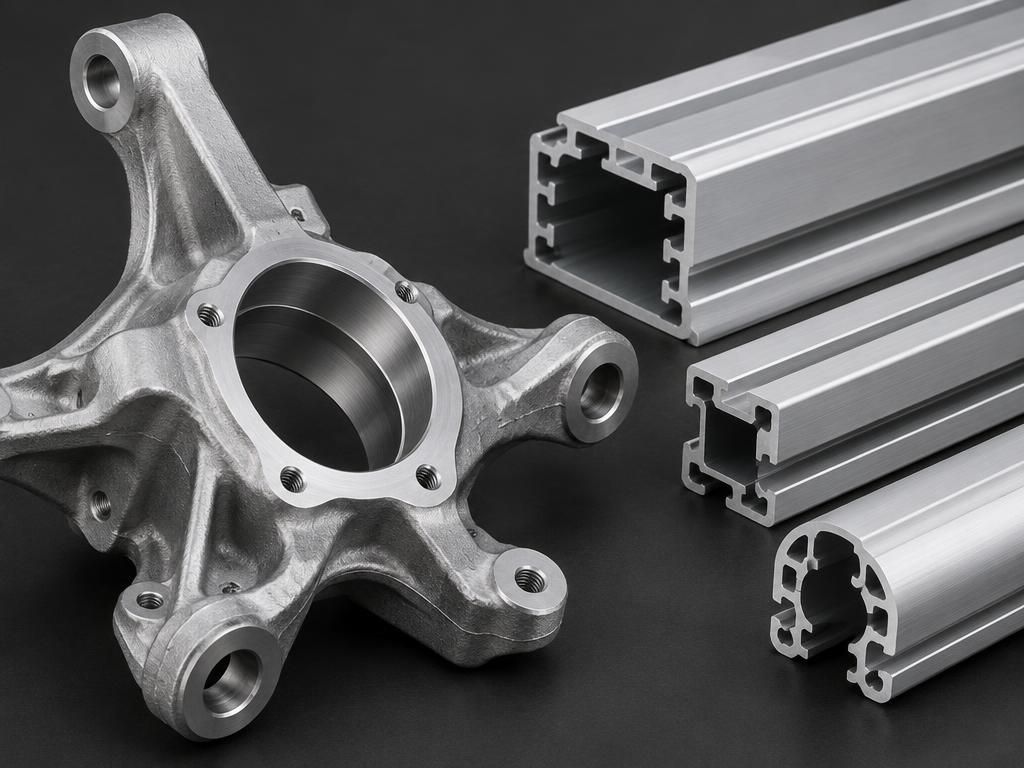
Cast aluminum suspension knuckle beside extruded aluminum profiles

Al-13

Aluminum Alloys

Roughly one third the density of steel, aluminum is a leading choice for lightweight vehicle design.

Learn more about aluminum alloys
What it is
Aluminum alloys combine aluminum with elements such as magnesium, silicon, copper, or zinc. Automotive grades are grouped into cast alloys and wrought series like 5xxx and 6xxx.
General properties
Low density, good corrosion resistance thanks to a natural oxide layer, high thermal conductivity, and good strength-to-weight ratio.
Advantages
  • Significant weight savings
  • Natural corrosion resistance
  • Can be cast, extruded, or stamped
Limitations
  • Higher material cost than steel
  • Requires different joining methods
  • Lower stiffness than steel for the same thickness
Common vehicle uses
Hoods, closures, engine blocks, cylinder heads, wheels, suspension parts, battery enclosures, and crash management systems.
Why manufacturers choose it
Aluminum is often selected where reducing mass improves efficiency, handling, or driving range enough to justify the added cost.
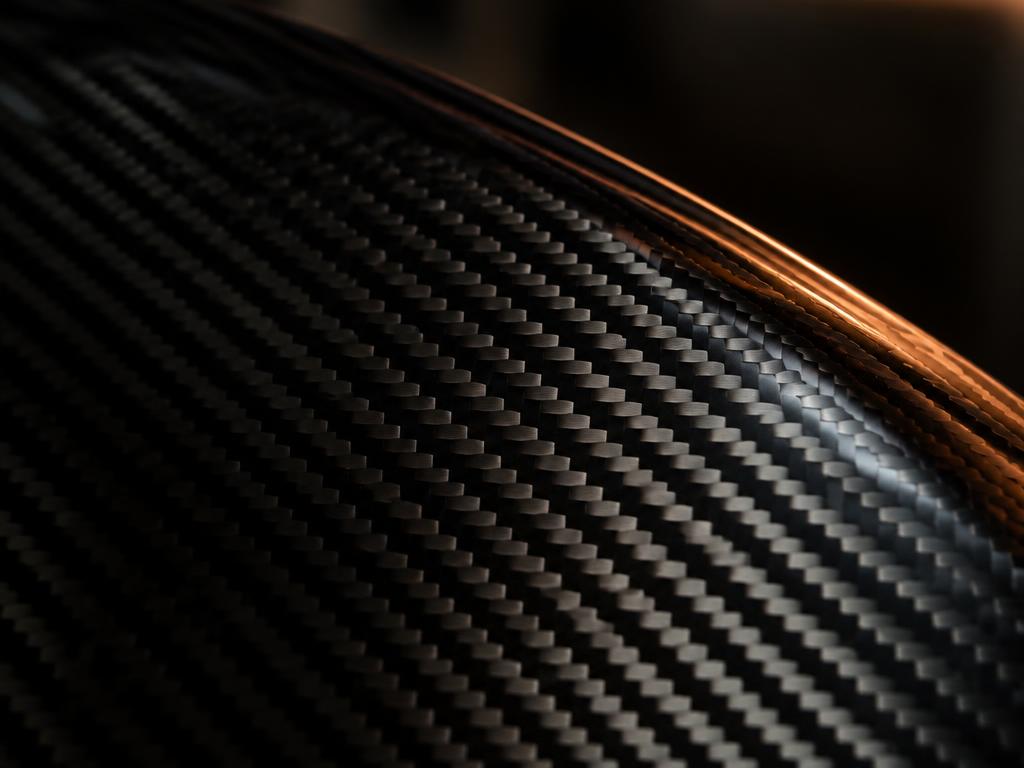
Close-up of woven carbon fiber on a curved automotive panel

C-06

Carbon Fiber

An extremely stiff and light reinforcement, carbon fiber appears in high-performance and specialty vehicles.

Learn more about carbon fiber
What it is
Carbon fiber reinforced polymer (CFRP) consists of thin carbon filaments bundled into tows, woven or laid into layers, and bound together with a resin such as epoxy.
General properties
Exceptional stiffness and strength for its weight, low thermal expansion, and properties that depend on fiber direction.
Advantages
  • Very high strength-to-weight ratio
  • Does not rust
  • Fiber orientation can be tailored to loads
Limitations
  • High material and processing cost
  • Slow cycle times for many methods
  • Complex repair and recycling
Common vehicle uses
Monocoque tubs, roof panels, driveshafts, aerodynamic parts, and interior trim in performance vehicles.
Why manufacturers choose it
Carbon fiber is chosen when minimum weight and maximum stiffness outweigh cost and production volume concerns.
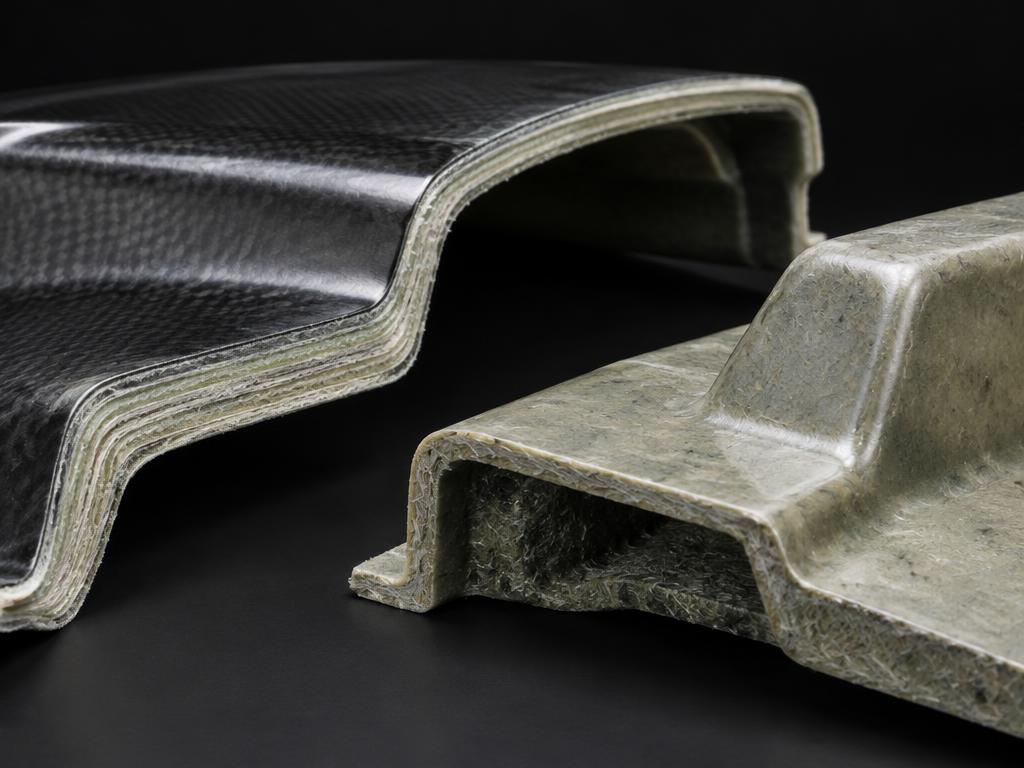
Cross sections of layered fiberglass composite automotive parts

Cm-05

Composite Materials

Engineered combinations of fibers and resins that balance weight, cost, and design freedom.

Learn more about composite materials
What it is
Automotive composites include glass fiber reinforced plastics, sheet molding compound (SMC), and natural fiber composites. Each pairs a reinforcing fiber with a polymer matrix.
General properties
Lower density than metals, good corrosion resistance, and the ability to form complex shapes in a single part.
Advantages
  • Part consolidation reduces assembly steps
  • Resists dents and corrosion
  • Lower tooling cost for some volumes
Limitations
  • Properties vary with fiber orientation
  • Surface finish can require extra work
  • Recycling is more complex than for metals
Common vehicle uses
Tailgates, pickup boxes, leaf springs, underbody shields, battery covers, and body panels.
Why manufacturers choose it
Composites are useful when designers want light, corrosion resistant parts with complex geometry at moderate cost.
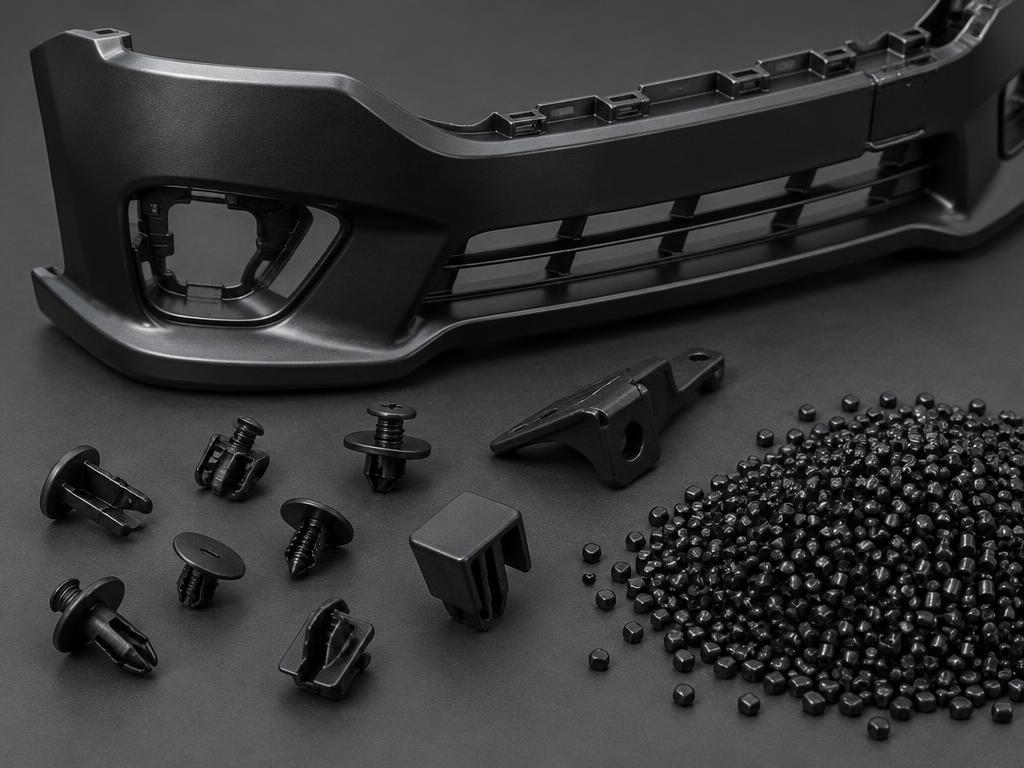
Injection molded black plastic bumper fascia, trim clips, and plastic pellets

Pl-07

Automotive Plastics

Polymers make up a large share of a vehicle's volume, from bumpers to dashboards and wiring insulation.

Learn more about automotive plastics
What it is
Common automotive plastics include polypropylene (PP), ABS, polycarbonate (PC), polyamide (nylon), and polyurethane (PU). Many are filled or reinforced to improve performance.
General properties
Low density, wide range of stiffness and flexibility, good chemical resistance, and moldable into detailed shapes.
Advantages
  • Very lightweight
  • Complex shapes in one molding
  • Integrated color and texture
Limitations
  • Lower strength and heat resistance than metals
  • Can degrade under UV exposure
  • Mixed plastics complicate recycling
Common vehicle uses
Bumper fascias, dashboards, door trims, fuel tanks, intake manifolds, lighting housings, and clips.
Why manufacturers choose it
Plastics are chosen for interior and exterior parts where weight, styling, and cost matter more than structural load bearing.
Edge of laminated automotive windshield glass showing its layers

Si-14

Automotive Glass

Safety glazing that provides visibility, structural support, and occupant protection.

Learn more about automotive glass
What it is
Windshields use laminated glass, two glass layers bonded to a plastic interlayer such as PVB. Side and rear windows often use tempered glass, which is heat treated for strength.
General properties
High transparency, good scratch resistance, and specific break patterns. Laminated glass holds together when cracked, while tempered glass breaks into small pieces.
Advantages
  • Clear, durable visibility
  • Bonded windshields add body stiffness
  • Can integrate acoustic and solar layers
Limitations
  • Relatively heavy
  • Brittle under sharp impact
  • Repairs are limited for tempered glass
Common vehicle uses
Windshields, side and rear windows, sunroofs, and panoramic roofs.
Why manufacturers choose it
Glass remains the standard for windows because it combines optical clarity, durability, and proven safety behavior.

02 / Properties

Material Properties Explained

The properties engineers weigh when selecting a material, described without the jargon.

Strength
How much force a material can carry before it permanently bends or breaks.
Press-hardened steel B-pillars resist intrusion in side impacts.
Weight and Density
Mass per unit of volume. Lower density means lighter parts at the same size.
Aluminum is about one third the density of steel.
Stiffness
Resistance to bending or flexing under load, measured by elastic modulus.
A stiff body structure improves handling precision.
Durability
Ability to survive repeated loading, vibration, and wear over years of use.
Suspension parts are designed for millions of load cycles.
Corrosion Resistance
How well a material resists rust and chemical attack from water, salt, and air.
Zinc coatings protect steel panels from road salt.
Heat Resistance
Ability to keep its shape and strength at high temperatures.
Exhaust and engine parts face temperatures that most plastics cannot tolerate.
Impact Behavior
How a material absorbs or transfers energy during a sudden collision.
Crumple zones fold in controlled patterns to absorb crash energy.

03 / Manufacturing

How Raw Materials Become Vehicle Parts

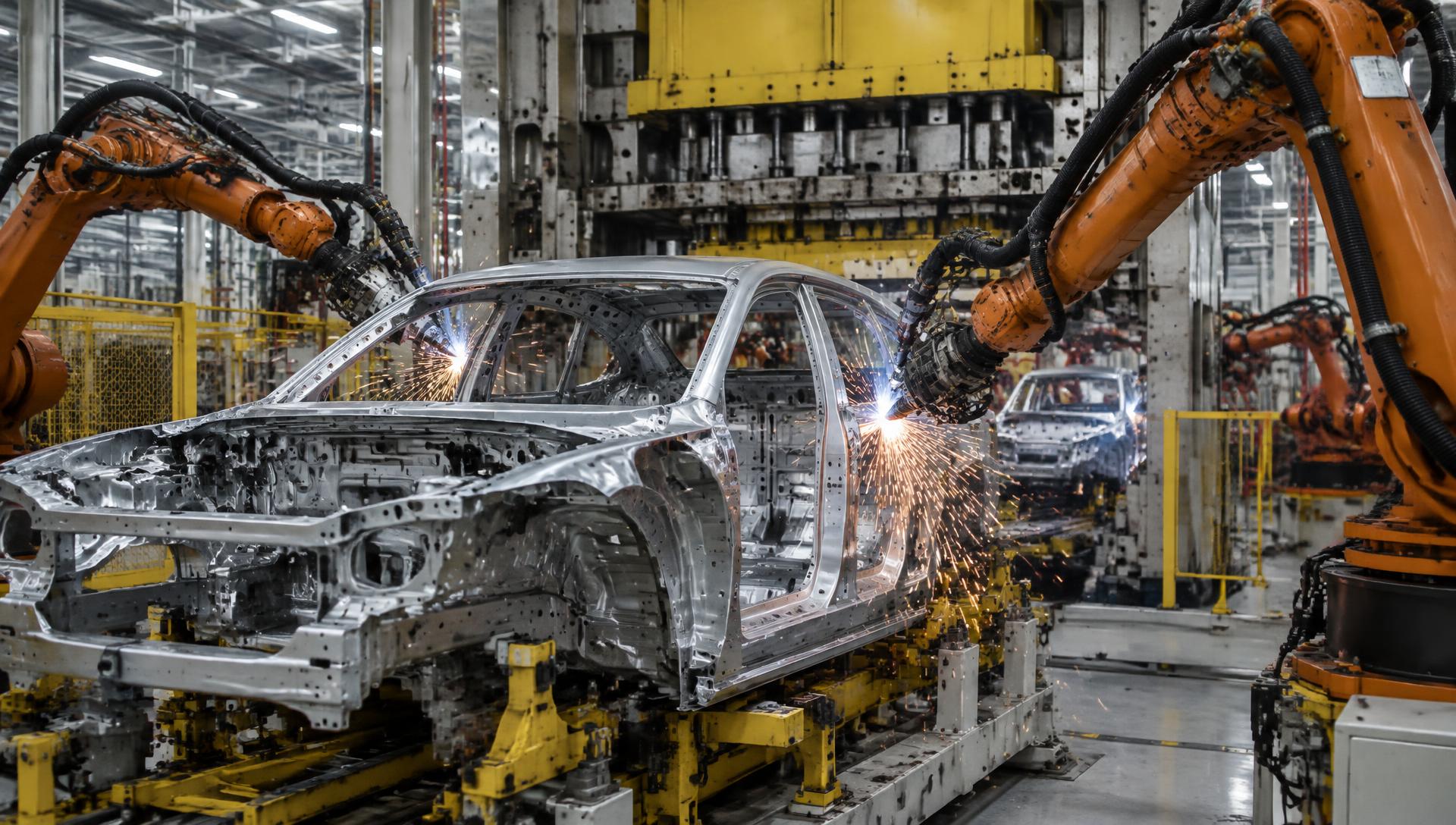
Robotic arms welding a steel vehicle body on an assembly line
  1. 01

    Metal Stamping

    Sheet metal is placed between matched dies in a press and formed into shape in one or more strokes.

    Typical partsDoors, hoods, fenders, roof panels, and structural brackets.

  2. 02

    Casting

    Molten metal is poured or injected into a mold and solidifies into the final shape. High-pressure die casting is common for aluminum.

    Typical partsEngine blocks, transmission cases, wheels, and large structural castings.

  3. 03

    Aluminum Extrusion

    A heated aluminum billet is pushed through a shaped die, producing long profiles with a constant cross section.

    Typical partsBumper beams, roof rails, crash boxes, and battery enclosure frames.

  4. 04

    Injection Molding

    Plastic pellets are melted and injected under pressure into a cooled steel mold, then ejected as finished parts.

    Typical partsDashboards, bumper fascias, trim panels, clips, and lighting housings.

  5. 05

    Welding and Joining

    Parts are fused with heat or pressure. Resistance spot welding, laser welding, and self-piercing rivets are common in body shops.

    Typical partsBody-in-white assemblies, frames, and exhaust systems.

  6. 06

    Adhesive Bonding

    Structural adhesives join parts across a continuous surface, spreading loads and allowing dissimilar materials to be connected.

    Typical partsMixed aluminum and steel bodies, windshields, and composite panels.

  7. 07

    Composite Manufacturing

    Fibers are laid into molds with resin and cured using heat and pressure, through methods such as resin transfer molding or compression molding.

    Typical partsCarbon fiber tubs, SMC tailgates, and lightweight body panels.

04 / Comparisons

Material Comparison Guides

No material is universally superior. Each comparison highlights the trade-offs.

FactorSteelAluminum
WeightHeavierAbout one third the density
CostLowerHigher
StiffnessHigher per thicknessLower, often offset with thicker sections
CorrosionNeeds coatingsNatural oxide protection
JoiningEasy spot weldingRivets, adhesives, special welding

Steel tends to win on cost and repairability, while aluminum wins on weight savings. Material selection always involves trade-offs between weight, strength, cost, manufacturing requirements, durability, and intended application.

05 / Features

What Alloy Theory Offers

  • 01

    Automotive Materials Library

    Seven core vehicle materials explained in plain language.

  • 02

    Visual Material Gallery

    Photography of each material and how it appears in vehicles.

  • 03

    Manufacturing Education Center

    Step by step overviews of stamping, casting, molding, and joining.

  • 04

    Material Comparison Guides

    Side by side trade-offs between common automotive materials.

  • 05

    Vehicle Construction Articles

    How body structures, closures, and glazing come together.

  • 06

    Engineering Terminology Glossary

    Clear definitions of common manufacturing terms.

  • 07

    Material Properties Reference

    Strength, stiffness, density, and more, explained simply.

  • 08

    SMS Updates

    Optional automotive material facts sent by text message.

06 / SMS Program

The Alloy Theory Automotive Materials SMS Program

Subscribers receive informational text messages featuring automotive material facts, vehicle construction explanations, manufacturing terminology, and insights into the materials used in automotive engineering.

Joining is completely optional. Every part of this website is available without signing up, and you choose exactly which message categories you want.

  • SMS participation is optional and never required to use this site.
  • You control which SMS categories you select, and you can reply STOP at any time.
  • Mobile opt-in information is never transferred to third parties for marketing or lead generation.
  • Alloy Theory is an independent informational resource and does not sell vehicles, parts, or repair services.
Opt-in Preferences (optional)

Account Notifications

Marketing

By checking an SMS consent box, you authorize Alloy Theory to send text messages to the phone number provided for the selected message category. Consent is optional and is not a condition of purchase, access, or use of this website. Message frequency varies unless otherwise stated. Msg & data rates may apply. Reply STOP to cancel or HELP for help. Mobile opt-in data and SMS consent will not be sold, shared, rented, or transferred to third parties for marketing or lead generation. See our Privacy Policy and SMS Terms of Service. Reply STOP to cancel. Reply HELP for help.

Get SMS Updates